






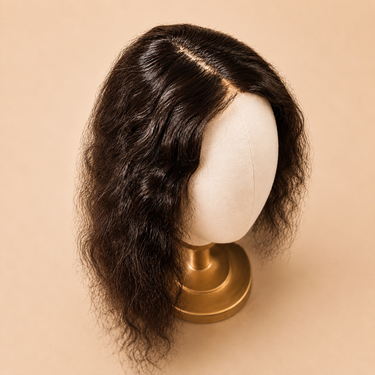

Coverage that uses the hair you still have
Hair Toppers
Learn whether a topper is right for you, how base size and construction change the result, and why fit, density and texture matter more than a product photo.
Start with the question that feels most like yours
Choose a path below, or read the complete guide from beginning to end.
A topper is the answer most people should hear first and the one most people skip past on the way to looking at wigs. If you still have hair around the sides and the back, a topper uses it. It is lighter, cooler, less expensive, and it lets your own hairline stay your own hairline.
It is also the piece people most often buy wrong, usually online, usually twice, before someone measures them properly. This page is here so that does not happen to you.
Topper or wig, honestly
A topper covers the top. It clips or attaches to the hair you still have, and that remaining hair has to be strong enough to hold it and dense enough to blend around it.
A topper is usually right if your thinning is at the part, the crown or the front, and the sides and back are holding. A wig is usually right if coverage needs to be complete, if your scalp needs protecting, or if the hair you have left cannot carry anything without pulling.
There is no prize for choosing the bigger option early. Plenty of people wear a topper for years, then a larger one, and only later a wig. Some never need one. See wigs if the answer turns out to be the other one.
It also helps to know that topper describes a range rather than one thing. They begin very small, a few inches across, for early or contained thinning at the crown. They go all the way up to a three quarter piece that covers most of the head and leaves only your own hairline and perimeter showing. Everything in between exists, which is why the useful question is almost never topper or wig. It is how much needs covering right now, and that answer is allowed to change over time.
Base size is the thing people get wrong
This is the single most common mistake and it is worth two minutes of your time.
The base is the panel the hair is tied into. Its size decides what is covered. Buy one too small and the thinning shows around the edges, which is the exact thing you were trying to solve. Buy one too big and it sits on hair that is doing fine, adds weight where you do not need it, and is harder to hide at the perimeter.
What you actually need to know is not your head size. It is how far your thinning extends in every direction from your part, measured while your hair is dry and sitting the way it normally does. Front to back, then side to side. Then add a margin, because thinning areas rarely have tidy edges and a base that stops exactly where the sparse hair stops will show a line.
Then there is placement. A base can sit forward to cover a receding front, or back to cover a crown, and the same base in two positions solves two completely different problems.
The Moxi Loxi Method™ uses guided photographs to capture visible shape, proportion, hairline context wherever you are, helping you begin with more individualized guidance rather than a generic size guess.
Construction, and what each thing buys you
Two toppers can look identical in a photograph and behave nothing alike. The difference is how the hair is attached to the base. That decides where you can part it, what it weighs, how cool it is to wear, how long it lasts and most of what it costs.
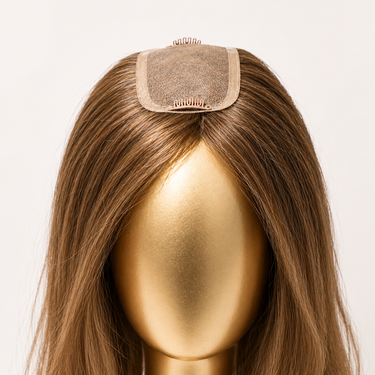
Silk top. Hair is tied through a layer of silk so the knots sit underneath and what shows at the parting is the impression of scalp. Silk tops are often chosen for a refined scalp appearance at the part, where people naturally look.
Monofilament. Hair is hand tied through a fine transparent mesh so each strand moves independently. Slightly less scalp illusion than silk, and more freedom, because the parting can be moved anywhere across the mono section rather than living in one place.
Lace front. Fine lace at the front hairline so hair reads softly against skin instead of starting in a line. Matters most if your thinning reaches forward, or if you want to wear your hair off your face.
Full lace. Lace throughout rather than only at the front. A lightweight, breathable option with broad styling flexibility, because hair can be brushed in different directions.
Wefting. Hair sewn onto a track and attached in rows rather than tied one strand at a time. Wefts add density efficiently, cost less and wear longer. What they cannot do is look like hair growing from a scalp, which is why they belong at the back and sides where nobody is looking for a parting, and not on top.
Not all lace is the same
Swiss lace is known for its fine, transparent appearance and can create a discreet transition against the skin. The trade is fragility. The finer the lace, the more carefully it has to be handled, and the more it benefits from being serviced rather than repaired after the fact.
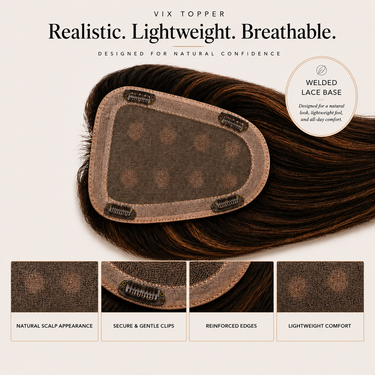
Welded lace has the hair fused to the lace rather than knotted through it, so there is no knot at the front at all. It can create a very flat, discreet hairline. It is a different material to live with than a knotted front, so it is worth understanding before you choose it rather than after.
If you are comparing two pieces and one is significantly cheaper, the lace is usually where the saving was made.
Knots, and the fastest way to spot a cheap piece
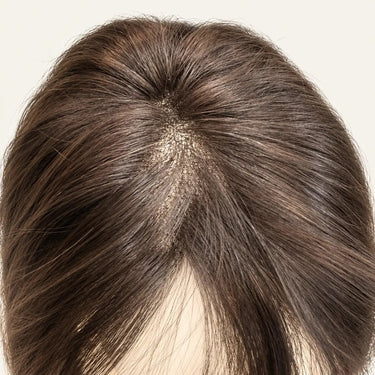
Wherever hair is tied into a base there is a knot. On a well made piece those knots are tiny and barely register. On a lower end piece they are larger, sit in an even grid, and read as visible dots against the scalp. It is the single most common giveaway on a topper that otherwise looks fine, and it is the first thing to look at in a close up photograph before you buy.
If you already own a piece with visible knots, this is fixable rather than fatal. Our Wig Grid Knot Erase is made for exactly this and works on both toppers and wigs.
Almost every good topper is a combination, and the combination is the real specification. A sensible common build is a silk or mono top where the part sits, lace at the front hairline, and wefting through the back for density and durability. Hand tied throughout is lighter, cooler and more natural in movement, and it costs more and wears out sooner. Wefted throughout is hardier and more affordable and will not give you a believable parting.
Every Moxi Loxi topper and wig is built with premium materials and craftsmanship, through factories and suppliers we have worked with for years rather than whoever is cheapest this season. That is what keeps the knot work fine, the lace consistent and the hair matching from one order to the next.
So the question is not which construction is best. It is which part of your head each element is solving for, and how much you want to spend on the parts nobody sees.
The hair itself, and why texture decides everything
Base construction gets discussed endlessly and hair texture barely gets mentioned, which is backwards. A topper fails to blend far more often because the hair is the wrong texture than because the base is the wrong size.
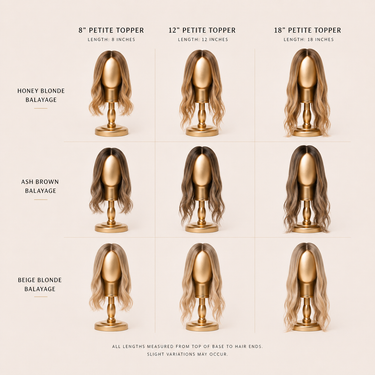
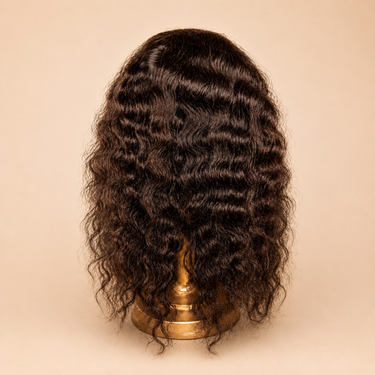
Human hair is not one material. Hair from different parts of the world varies in diameter, in how the cuticle lies, in natural wave pattern, in how it accepts color and in how it behaves in humidity. Fine, silky, very straight hair will not sit convincingly in the middle of coarse hair with natural movement, and the reverse is just as visible. That is not a quality problem. It is a matching problem, and styling does not fix it.
This is why we source from several regions rather than one, selecting by texture, diameter, wave pattern and grade to match the client rather than to fill a shelf. We buy through partners we have worked with over many years, to support consistent quality and supply. Long relationships matter more than price here. Consistency between one order and the next is what lets us remake a piece years from now and have it still match you.
What that means in practice: if your own hair is fine and straight, coarse hair will read as a hairpiece no matter how well it is cut. If your hair is thick with natural movement, silky straight hair will slide out of place and refuse to hold a shape. Tell us what your hair actually does, particularly after washing and in humidity, and we match to that rather than to a swatch.
Texture is also the hardest thing to judge from a photograph on a screen, which is a good reason to have it matched rather than guessed. Distance changes the process. It does not change whether the work can be done.
Density, and why less is usually right
Density is how much hair is in the base. It is the setting people most often push too high, and it is the one that most often gives a piece away.
Toppers are built dense because density photographs well and because more hair feels like better value. Real hair is not that dense, particularly at the crown, particularly past forty, and particularly on someone who is thinning. A topper set heavier than the hair around it does not read as full. It reads as a hairpiece, and it announces itself from behind and in daylight, which are the two conditions you cannot control.
There is a physical cost too. Density is weight, and weight is tension on the hair holding the piece on. A heavy topper clipped into fine hair is a traction problem waiting to happen. Lighter is cooler, kinder and usually more convincing.
Density also has to be graded rather than uniform. Real hair is sparser at the hairline and along the part and fuller through the mid lengths. A piece with the same density everywhere looks solid at exactly the two places people look. Thinning the hairline and the parting by hand is part of what happens to every piece before you wear it.
One thing worth knowing before you order: density can always be taken out and it cannot be put back. Pieces are finished on the lighter side deliberately, and built up only where you genuinely need it.
How it stays on
Clips. The standard, and completely fine for most people. On and off daily, no commitment, no adhesive. The one caution is tension: clips sitting in the same few hairs day after day is how traction damage starts, so placement gets moved and checked.
Semi permanent attachment, including Microlines. Instead of clipping on and off, the topper is attached to your own hair and stays in place continuously. It is designed for continuous wear and may reduce the daily step of applying and removing a topper. It is serviced on a schedule as your hair grows.
Semi permanent is not right for everyone. Actively shedding hair, very fine hair or an unsettled scalp all need addressing first. That assessment happens before anything is attached, never after. Read more about integration and semi permanent attachment.
The Moxi Loxi range
Chosen for different situations rather than to fill a page. Every piece is fitted, cut and finished for you before you wear it.
- Aubrey, a petite crown volume topper, for early or contained thinning at the crown.
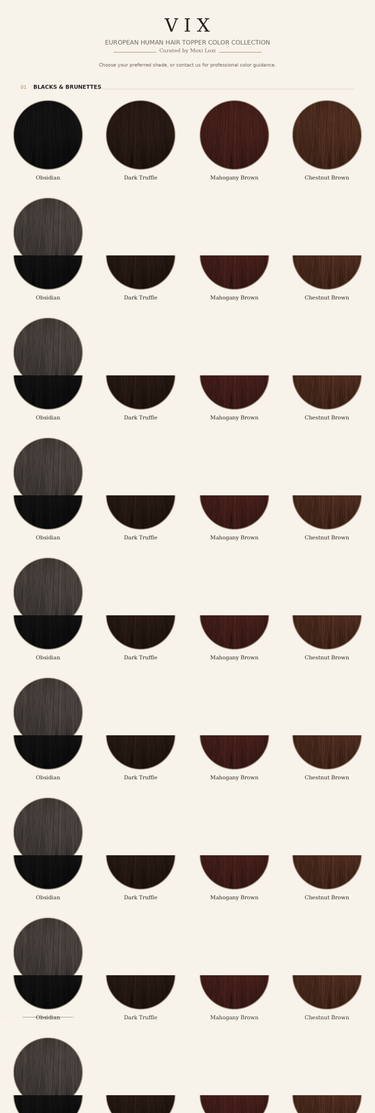
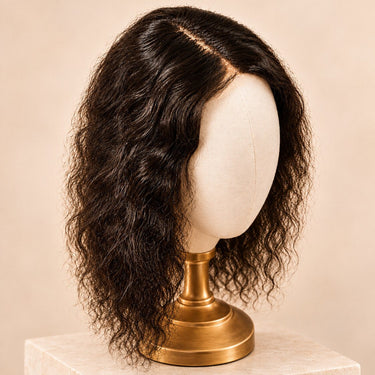
- VIX, lightweight coverage for moderate thinning.
- Brixa, ultra lightweight full lace, for breathability and styling freedom.
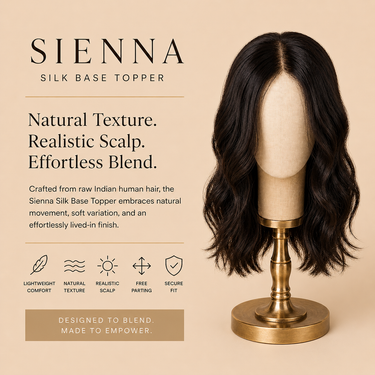
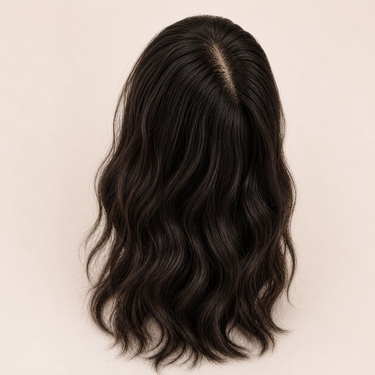
- SIENNA, a natural texture silk base topper, for the most convincing parting.
- Lumi, natural texture with a lace front, where the thinning reaches forward.
If none of these is right, that is normal and not the end of the conversation. Most of what we make is not listed. See custom solutions.
Color and blending
A topper sits in the middle of your own hair, which makes color less forgiving than it is on a wig. It has to match what is around it in daylight, including your root, and it has to keep matching when you next get your own color done.
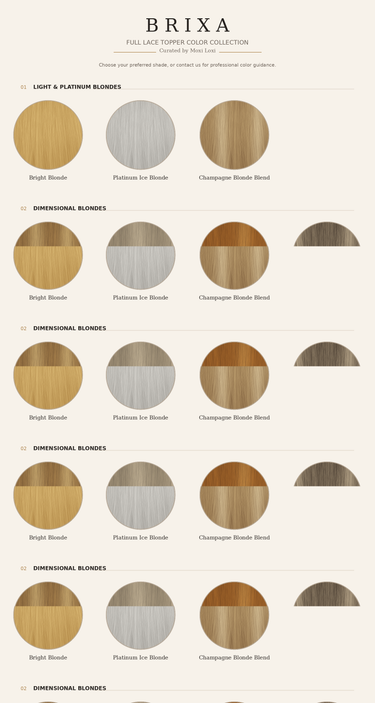
Color is matched and adjusted here rather than picked from a ring, and the piece is cut into your own hair so there is no edge where one becomes the other. That blending is what the boutique is for. It is also done at a distance, using The Moxi Loxi Method™ with a virtual consultation, when you cannot get to Danville.
Protect the piece you choose
Your care routine should be part of the purchase.
Store and style
THE VOYAGE is the primary home for a removable topper. It protects the shape from dust, pets, children and crushing, and includes the suction styling stand, silk bag and Eco Brush. It is $249, or $179 with each eligible wig or topper, saving $70 per eligible piece.
Wash and hydrate
Cleanse with Pure Wash, condition with Pure Conditioner, then apply Foundation Mist as the lightweight leave in through towel dried lengths and ends.
Refresh and finish
Use Aura Restore for odor between washes, Tease for alcohol free root lift and Fixation for brushable hold. If the topper is worn semi permanently, the care products still apply, but THE VOYAGE is not needed while it is attached.
Looking after it
Toppers live a hard life because they sit where you part, style and touch your hair most. Detangle from the ends upward, keep heat off it, and wash it when it stops moving the way it should rather than on a schedule. See accessories and care for the routine and scalp and hair care for the hair underneath, which still needs looking after.
Before you order
Prepared for you. Final sale. Supported for 30 days. Every Moxi Loxi topper is professionally prepared using the preferences you share with us and comes with our 30 Day Fit and Finish Promise. If something is not right, tell us within 30 days of delivery. Read the full returns, exchanges and fit promise before buying.
Unsure about base size, density, color or attachment? Ask before you order rather than after. The Moxi Loxi Method™ or a consultation both cost less than the wrong topper.
moxi-ecommerce-second-piece-link-v1Planning a second piece?
A second wig or topper can give you a dependable rotation for everyday wear, travel, exercise or the days when one piece is being cared for. Plan your second wig or topper around the fit, coverage and lifestyle needs that matter to you.
Written by Aria Pilar, Founder and Trichologist at Moxi Loxi, Danville, California. More than 30 years of experience in hair, beauty and alternative hair solutions. This page is educational and is not medical advice.
Your next step
You do not have to work this out alone.
Bring your questions, your history and any photographs that help. We will explain what may suit you, what it involves and what to expect before you decide.